If you're looking for a mini PC to upgrade your old desktop computer, set up a compact office, or enjoy emulation and light gaming, you've probably encountered the usual dilemma: should you settle for a Ryzen 5 or is it worth stretching your budget to a Ryzen 7?
The short answer is that it's not always worth paying more for a Ryzen 7, unless you choose the right technical generation.
In today's compact computer market, brands like Beelink, GMKtec, FIREBAT, or ACEMAGIC market processors with misleading names, where a modern Ryzen 5 far surpasses a Ryzen 7 from previous generations in fluidity and gaming.
In this guide, we break down the real performance differences, debunk the myths surrounding AMD brand names, and analyze the 10 best current models on AliExpress and Amazon, including their prices, specifications, and direct links to help you make the right purchase.
The name trap: Why a Ryzen 7 can be worse than a Ryzen 5?
The biggest mistake a typical buyer makes is focusing solely on the "Ryzen 5" or "Ryzen 7" label. AMD uses a naming scheme where the first digit often disguises older architectures with newer names.
A computer processor depends fundamentally on two factors:
-
Core architecture (Zen): This determines how quickly each CPU core performs an individual task. A core with a modern architecture ( Zen 3 or Zen 4 ) is drastically more efficient and faster than a Zen 2 core.
-
The integrated graphics architecture (iGPU): This is the video engine that dictates whether you can play games smoothly, edit video, or move high-resolution monitors without stuttering.
For example, a processor like the Ryzen 7 5700U has 8 cores, but they are built on the older Zen 2 architecture and use Radeon Vega graphics. In contrast, a processor like the Ryzen 5 5600H has 6 cores, but they are based on Zen 3 and operate at 45 watts, providing greater responsiveness when opening demanding programs and improved performance in everyday tasks.
If the jump to Ryzen 7 is not accompanied by modern graphics ( RDNA 2 or RDNA 3 ), paying more money for "eight slow cores" does not provide any perceptible advantage for the average user.
Technical comparison: Differences in everyday use
To understand if the additional investment is worthwhile, it is advisable to analyze how each range performs in the most frequent computing tasks.
Office automation, web browsing and teleworking
For writing documents, managing large spreadsheets, making Zoom video calls, and keeping dozens of tabs open in Google Chrome, a Ryzen 5 is more than enough. Any 6-core, 12-thread chip handles these workloads with ease, without exceeding 25% CPU usage. Upgrading to a Ryzen 7 in this scenario doesn't offer any noticeable speed improvement, as the determining factor for smooth performance is having a fast NVMe SSD and at least 16 GB of RAM.
Games, emulation and multimedia
This is where the real divide is drawn. The budget Ryzen 5 processors (5000 series) feature Radeon Vega graphics, which are sufficient for simple titles like League of Legends, Counter-Strike 2 at low resolution, or classic emulators up to PlayStation 2.
If your goal is to smoothly play games like GTA V, Forza Horizon 5, or Cyberpunk 2077 at 1080p on medium settings, or to emulate consoles like the Nintendo Switch and PS3, then investing in a Ryzen 7 with Radeon 780M graphics (such as models based on Zen 4 or the H 255 series) is definitely worthwhile. Its graphics power doubles the performance of basic chips, turning this small box into a true desktop console.
Comparison table: The 10 best Mini PCs with Ryzen 5 and Ryzen 7
This selection brings together the most competitive options currently on the market, contrasting economical import options on AliExpress with alternatives with immediate shipping and direct guarantee on Amazon.
| Model | Platform | Processor / Graphics | RAM/SSD | Approximate price | Sales and Valuation | Link |
|---|---|---|---|---|---|---|
| TexHoo ITX | AliExpress | Ryzen 7 5700U · Vega 8 | 16GB / 256GB | 187,39 € | 5.0 (2 sold) | Buy on AliExpress |
| PELADN WO4 | AliExpress | Ryzen 5 5600H · Vega 7 | 16GB / 512GB | 208,32 € | 4.8 (19 sold) | Buy on AliExpress |
| TexHoo 5600U | AliExpress | Ryzen 5 5600U · Vega 7 | Barebone (Including RAM/SSD) | 227,69 € | 5.0 (6 sold) | Buy on AliExpress |
| BOSGAME E5 Plus | Amazon | Ryzen 5 5400U · Vega 6 | 8GB / 256GB | $229.99 | 4.3 (218 reviews / +500 per month) | Buy on Amazon |
| Leno Mini PC | AliExpress | Ryzen 5 6600H · 660M | 16GB / 512GB | 288,69 € | 5.0 (30 sold) | Buy on AliExpress |
| FIREBAT AM02 | AliExpress | Ryzen 7 H 255 · 780M | 16GB / 512GB | 297,69 € | 4.9 (122 sold) | Buy on AliExpress |
| GMKtec M7 | AliExpress | Ryzen 7 PRO 6850H · 680M | Barebone (Including RAM/SSD) | 299,70 € | 5.0 (3 sold) | Buy on AliExpress |
| Beelink SER5 MAX | Amazon | Ryzen 7 7735U · 680M | 24GB / 500GB | $489.00 | 4.4 (176 reviews / +50 per month) | Buy on Amazon |
| GEEKOM A7 | Amazon | Ryzen 5 7535HS · 660M | 16GB / 1TB | $494.10 | 4.6 (10 reviews / +50 per month) | Buy on Amazon |
| ACEMAGICIAN S3A | Amazon | Ryzen 7 H 255 · 780M | 16GB / 512GB | $499.99 | 4.5 (221 reviews / +100 per month) | Buy on Amazon |
Analysis of the best buys according to your budget
1. The king of the tight budget (~€200): PELADN WO4

For those looking to spend as little as possible without sacrificing speed, the PELADN WO4 is the undisputed benchmark at €208.32. It features a Ryzen 5 5600H processor with 6 cores and 12 threads, based on pure Zen 3 architecture. Its 45-watt thermal profile allows it to maintain high operating frequencies without overheating, and it includes 16 GB of RAM, a 512 GB NVMe SSD, and a 2.5 GbE network card. It's the recommended option for replacing older office towers or creating a quiet home server.
2. The sweet spot of the market (~€300): FIREBAT AM02
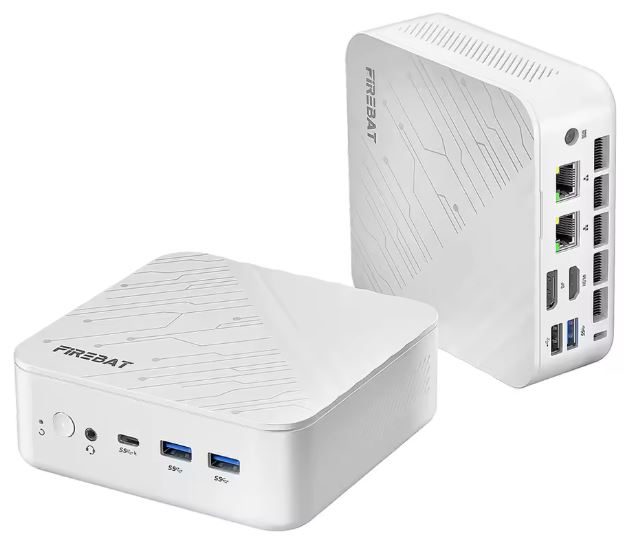
The FIREBAT AM02 for €297.69 is a clear example of when it is worth paying the difference for a Ryzen 7.
-
It incorporates the Ryzen 7 H 255 processor, an 8-core, 16-thread chip with modern Zen 4 architecture in 4 nanometers (equivalent to the 8745HS without the AI NPU).
-
Its integrated graphics card is the Radeon 780M, accompanied by DDR5 memory.
-
Compared to a mini PC with a Ryzen 5 6600H that costs €288.69, paying just €9 more gives you two additional cores and 60% more graphics power. It's the smartest purchase in the current catalog.
3. For enthusiasts and future expansions: GMKtec M7

For €299.70, the GMKtec M7 barebone offers a key differentiator: a native OCuLink port in addition to USB4 connectors. This interface allows for the future connection of an external desktop graphics card (eGPU) with significantly higher bandwidth than Thunderbolt, transforming the mini PC into a high-end gaming station without data transfer bottlenecks.
4. The best alternative with a full guarantee: ACEMAGICIAN S3A
If you prefer Amazon for its fast delivery and return policy, the ACEMAGICIAN S3A at $499.99 makes buying a Ryzen 5 on this platform pointless. The GEEKOM A7 with a Ryzen 5 7535HS costs $494.10; for just $5.89 more, the S3A jumps to the Zen 4 architecture with the Ryzen 7 H 255 processor and Radeon 780M graphics in a vertical tower form factor with excellent ventilation.
Final verdict: Which one should you buy?
The purchase decision between these two ranges can be summarized in three very defined profiles:
-
Buy a Ryzen 5 if your budget is under €250: Don't stretch your budget to buy a cheap, older-generation Ryzen 7. The PELADN WO4 (Ryzen 5 5600H) will give you better performance for everyday use than outdated Ryzen 7 processors.
-
Buy a Ryzen 7 if you're going to play games or emulate: In the €300 range on AliExpress or $500 on Amazon, the price difference with a modern Ryzen 5 is practically nonexistent (between €9 and $15). In these cases, the FIREBAT AM02 or the ACEMAGICIAN S3A with a Ryzen 7 H 255 chip and Radeon 780M offer improvements in gaming, fluidity, and longevity that justify every euro spent.
-
Always check the architecture: If a mini PC with a Ryzen 7 uses DDR4 memory and Radeon Vega graphics, avoid it. Always look for models that specify Radeon 680M or Radeon 780M graphics with DDR5 memory, which represent the true leap in performance you expect when buying a higher-end processor.