The popular Asian manufacturer has updated its M7 series with a new variant equipped with the Intel Core i7-1185G7 processor, maintaining its acclaimed ultra-compact metal chassis and minimal noise level. We analyze whether this discounted version is worth it and how it differs from the AMD Ryzen model.
🔥 Ninkear M7 (Intel Core i7) Offer
-
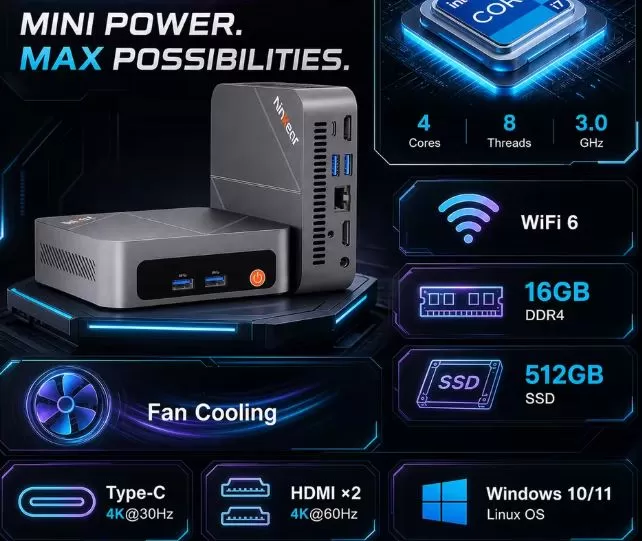
Base specifications: 16 GB DDR4 RAM | 512 GB NVMe SSD | Intel Iris Xe Graphics (96 EUs) | Triple 4K Display
-
Status: Launch discount
-
Purchase link: → See Price and Availability
Following the success of its AMD-based version, the Ninkear M7 arrives on the market with a revamped configuration featuring Intel silicon. This revision retains its strengths in build quality, 100% aluminum chassis, and extremely quiet operation, but introduces interesting improvements in single-core performance, video codecs, and connectivity.
🔍 Looking for comprehensive chassis analysis, noise and thermal testing?
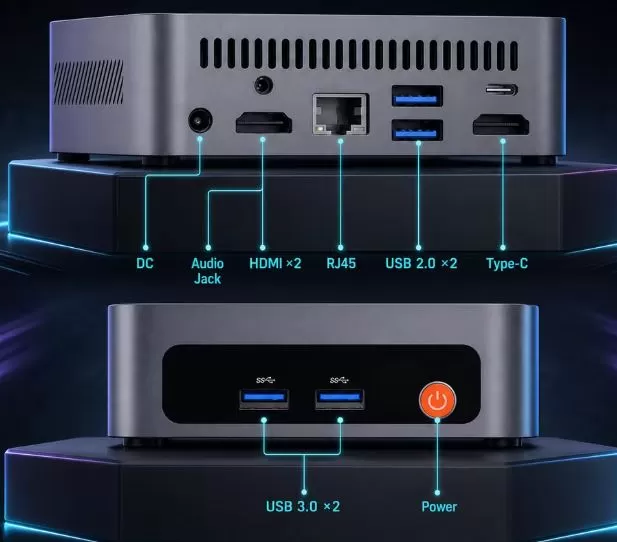
Since the exterior design, ventilation system, and expansion options are identical, you can find all the construction details and acoustic performance information in our full Ninkear M7 review.
Key specifications of the Intel Core i7 version
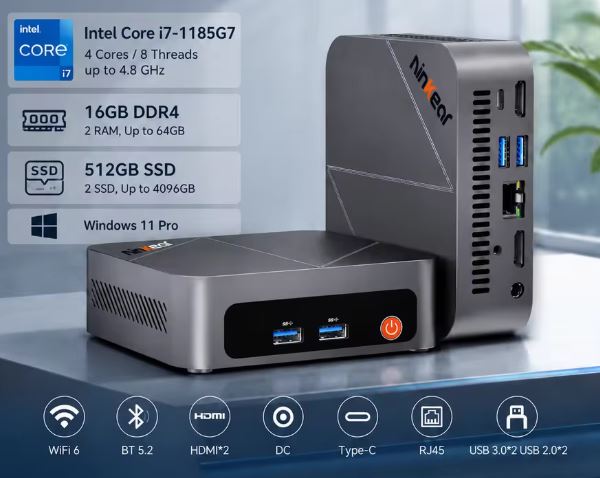
| Component | Technical details |
|---|---|
| Processor | Intel Core i7-1185G7 (4 cores / 8 threads, Turbo up to 4.8 GHz, 10nm SuperFin) |
| Integrated graphics | Intel Iris Xe Graphics (96 Execution Units) |
| RAM | 16 GB DDR4 (2x SO-DIMM slots, expandable to 64 GB) |
| Storage | 512 GB SSD M.2 NVMe PCIe 4.0 (Expandable via secondary M.2 slot). Total up to 4 TB |
| Video outputs | Triple 4K display (2x HDMI 2.0 + 1x USB-C DisplayPort) |
| Network connectivity | Wi-Fi 6 (802.11ax), Bluetooth 5.2, RJ45 Gigabit LAN |
| Operating System | Windows 11 Pro pre-installed and activated |
What does this Intel variant offer compared to the AMD version?
-
Superior Single-Core Performance: The Intel Core i7-1185G7 reaches Boost frequencies of up to 4.8 GHz, resulting in slightly faster program opening and response times for everyday office tasks.
-
Better iGPU and Intel QuickSync: Intel Iris Xe graphics (96 EUs) outperform the AMD model's Radeon Vega 7 architecture in raw performance, also offering hardware acceleration for decoding modern codecs such as AV1 and Intel QuickSync (highly appreciated for HTPC media centers and transcoding in Plex).
-
PCIe 4.0 Support: Unlike the PCIe 3.0 port on the Ryzen version, Intel's controller supports 4th generation M.2 NVMe SSDs, achieving higher transfer rates.
Which one to choose? Ninkear M7 Intel i7 vs. AMD Ryzen 5
Both options share the same high-quality aluminum chassis and ultra-quiet operation (~24 dB), but they cater to different user profiles:
Choose the Intel Core i7 version if:
-
You are looking for more power in the integrated graphics card (Iris Xe 96EUs).
-
You will use the PC as a media server / HTPC (AV1 and QuickSync support).
-
You prioritize single-core response speed in office tasks.
Choose the AMD Ryzen 5 (7430U) version if:
-
You need higher multi-threaded performance (6 cores / 12 threads vs. Intel's 4C/8T).
-
You will be performing heavy tasks such as compilation, compression, or virtualization.
-
You prioritize the lowest continuous power consumption under load.
Verdict: Is the offer worth it?
If you find the Ninkear M7 with Intel Core i7-1185G7 at a competitive price, it becomes a fantastic option for users looking for an ultra-quiet, elegant, well-built computer with more than enough power for everyday tasks, remote desktop work, and advanced multimedia consumption.