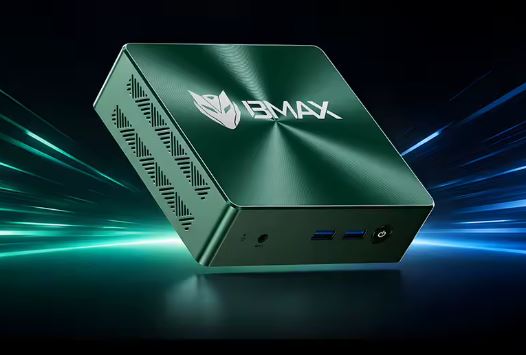
The BMAX B6 is a mini PC designed especially as a second computer, ideal for heavy web browsing and office work thanks to its solid single-threaded performance, accompanied by 12 GB of memory and a truly tiny chassis.
Its limitations lie in its soldered memory and wireless connectivity tied to older standards. If you find it discounted compared to N100 processor-based systems, it represents a well-rounded alternative for compact workstations or low-power home servers.
-
Pros:
-
📏 Ultra-compact metal chassis (12.5 × 11.2 × 3.4 cm) with VESA mount
-
⚡ Excellent single-thread response with peaks of 3.6 GHz
-
💾 Second free M.2 slot for adding additional storage up to 4 TB
-
🪟 Windows 11 Pro license with quick recovery partition using the F9 key
-
🔘 Physical Clear CMOS button on the front for BIOS emergencies
-
-
Cons:
-
🔒 LPDDR3 RAM soldered to the motherboard with no possibility of expansion
-
📉 Limitation to two physical cores in heavy multitasking loads
-
📺 HDMI 1.4 port limited to 4K at 30 Hz (4K at 60 Hz requires DisplayPort)
-
📶 WiFi 5 connectivity without native support for WiFi 6 or USB-C
-
🛒 See prices for the BMAX B6 mini PC on Amazon
🛒 BMAX B6 prices on AliExpress
Unboxing and package contents
The experience of opening the box is straightforward and functional.
The package includes the BMAX B6 itself protected by dense foam, a compact 12V 3A power adapter with European plug, a 1.5-meter HDMI cable, the VESA mounting plate with its screw set, and a multilingual quick start guide.
Bmax B6 Specification Sheet
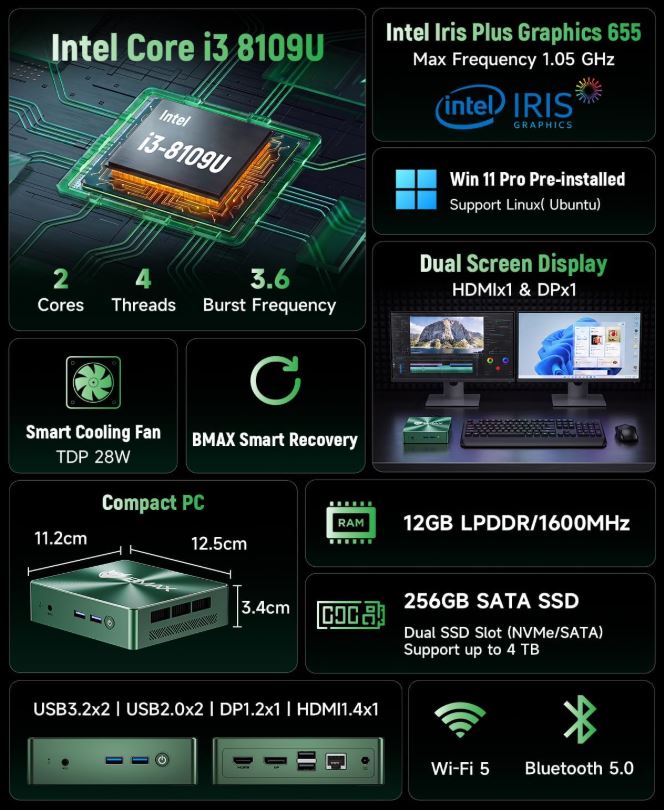
| Component | Technical details |
|---|---|
| Processor | Intel Core i3-8109U (2 cores, 4 threads, 3.00 GHz base, 3.60 GHz turbo, 28 W TDP) |
| Integrated graphics | Intel Iris Plus Graphics 655 (128 MB eDRAM, up to 1.05 GHz) |
| RAM | 12 GB LPDDR3 at 1600 MHz in soldered dual-channel configuration |
| Main storage | 256GB M.2 2280 SATA SSD |
| Internal expansion | Second available M.2 2280 NVMe/SATA slot (up to 4 TB combined) |
| Video connectivity | 1× HDMI 1.4 (4K at 30 Hz) + 1× DisplayPort 1.2 (4K at 60 Hz) |
| USB ports | 2 x Front USB 3.2 Gen 1 ports + 2 x Rear USB 2.0 ports |
| Networks and communication | Gigabit Ethernet RJ45, dual-band WiFi 5 (802.11ac), Bluetooth 5.0 |
| Audio and utilities | 3.5 mm jack connector for audio/microphone combo, front Clear CMOS hole |
| Dimensions and weight | 12.5 × 11.2 × 3.4 cm; verified weight of 318 grams |
| Operating system | Windows 11 Pro pre-installed and activated |
Design, multimedia, and physical connectivity
Build quality and in-hand feel
The device features a dark metallic green finish with a concentric pattern on the top cover that elegantly reflects light.
The casing combines a rigid structure with generous perimeter grilles designed to maximize the intake and expulsion of hot air.
Weighing in at 318 grams, it practically disappears when mounted behind a monitor using the included VESA mount, reducing the space it occupies on the work table to zero.
Screen outputs and multimedia experience
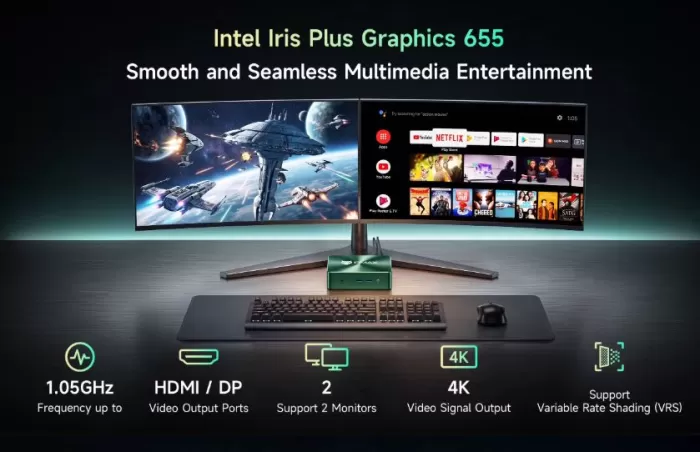
During our tests, we paired two monitors to verify the manufacturer's claims regarding multi-monitor output. Connected via the DisplayPort 1.2 port, we obtained a flawless signal at 3840×2160 pixels at 60 Hz without any flickering. However, the HDMI 1.4 output is limited to 30 Hz at native 4K resolution, so we recommend configuring this port to 1080p or 1440p to maintain a smooth 60 Hz refresh rate on the desktop.
The integrated Iris Plus 655 GPU features hardware acceleration for HEVC and VP9 codecs, playing 4K YouTube content without noticeable frame drops. However, it lacks silicon decoding for the AV1 codec, delegating that task to the CPU.
As for the acoustic aspect, it does not incorporate integrated speakers, transferring the analog sound through the 3.5 mm front jack connector or through the digital video outputs.
Peripheral connectivity and motherboard extras
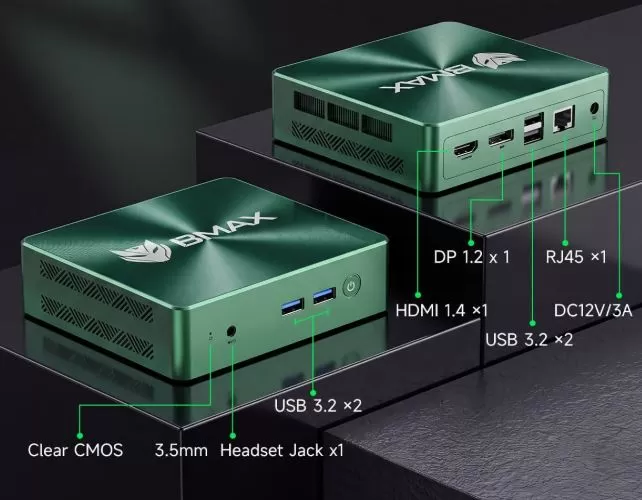
The port layout is logical for everyday use. The front panel houses the usual ports: two USB 3.2 5Gbps ports for external storage and fast peripherals, along with the power button and the Clear CMOS hole. The rear panel contains the power connector, the Gigabit RJ45 port, two USB 2.0 ports reserved for the keyboard and mouse, and the video outputs.
Keep in mind that this model lacks USB-C ports, an SD card reader, NFC chips, and biometric fingerprint sensors. It also lacks a water and dust resistance rating (IP rating), so the ventilation grilles must be kept clear in humid or dusty environments.
Actual performance: Overall fluidity and software environment
The device comes with Windows 11 Pro pre-installed, free of any promotional or residual software. The Core i3-8109U processor maintains sustained frequencies close to 3.4 GHz under normal use. With more than fifteen tabs open in Google Chrome, large spreadsheets in Excel, and Spotify playing in the background, the 12 GB of RAM provides ample headroom without any noticeable drop in responsiveness.
A very convenient feature is the BMAX Smart Recovery environment: by repeatedly pressing the F9 key when turning on the machine, you can access a native menu that allows you to reinstall the factory Windows image in less than ten minutes without requiring external USB sticks.
🛒 See prices for the BMAX B6 mini PC on Amazon
🛒 BMAX B6 prices on AliExpress
Energy efficiency, temperature and noise
At complete idle on the Windows desktop, we measured a power consumption of just 7.8 watts at the wall outlet. During typical office and browsing sessions, consumption ranged between 14 and 18 watts, while running a combined CPU and GPU stress test, consumption climbed to 31 watts, within the range of the supplied 36-watt power adapter.
The thermal system employs a dual-finned copper heat pipe heatsink assisted by an intelligent turbine. With an ambient temperature of 21°C, the processor idles at 39°C and reaches a peak of 78°C under continuous maximum load, without exhibiting aggressive thermal throttling. At a distance of 40 centimeters, the sound level meter registered 33 dBA during everyday tasks, rising to 38.5 dBA under continuous stress tests, resulting in a soft hum that does not interfere with a workday.
Technical tests and benchmarks
We subjected the BMAX B6 to standardized tests on our laboratory bench to compare its performance with independent industry figures:
| Synthetic test | BMAX B6 Score (i3-8109U) | Direct comparison Intel N100 |
|---|---|---|
| PassMark CPU Mark (Multithreaded) | 4,172 points | 5,307 points (+27% N100) |
| PassMark Single Thread | 2,066 points | 1,907 points (+8% i3-8109U) |
| Cinebench R23 (Single-Core) | 985 points | 930 points |
| Cinebench R23 (Multi-Core) | 2,140 points | 2,890 points |
| CrystalDiskMark (SSD Sequential Read) | 542 MB/s (SATA M.2) | 520 - 1,700 MB/s (depending on the model) |
| CrystalDiskMark (SSD Sequential Write) | 488 MB/s (SATA M.2) | 490 - 1,500 MB/s (depending on the model) |
| iperf3 network performance (Gigabit Ethernet) | 941 Mbps | 940 Mbps |
| iperf3 network performance (WiFi 5 at 5 GHz) | 385 Mbps | 520 Mbps (on devices with WiFi 6) |
The results confirm that in individual operations (program launches, web script loading, and browsing), the i3-8109U feels slightly more responsive due to its peak frequency of 3.6 GHz. However, when a task demands the simultaneous use of all threads, the four physical cores of the N100's Alder Lake-N architecture provide a clear advantage with almost a third more computing power.
Light gaming and classic emulation
Let's be clear: this mini PC is not designed for next-gen video games. Titles from the last decade, such as Left 4 Dead 2 or Portal 2, run at over 50 frames per second at 720p on medium settings.
In retro emulation the experience is extremely rewarding: classic consoles like NES, SNES, Mega Drive, Game Boy Advance and PlayStation 1 run with absolute ease and applied filters.
PSP emulation using PPSSPP allows scaling the resolution to 2x with stable 60fps rates in titles like God of War: Ghost of Sparta.
On PlayStation 2, performance is mixed: light games like Final Fantasy X are perfectly playable, but demanding titles like Shadow of the Colossus suffer from frame rate drops due to the limitations of having only two processor cores.
Market expansion possibilities and comparison
Storage and memory upgrades
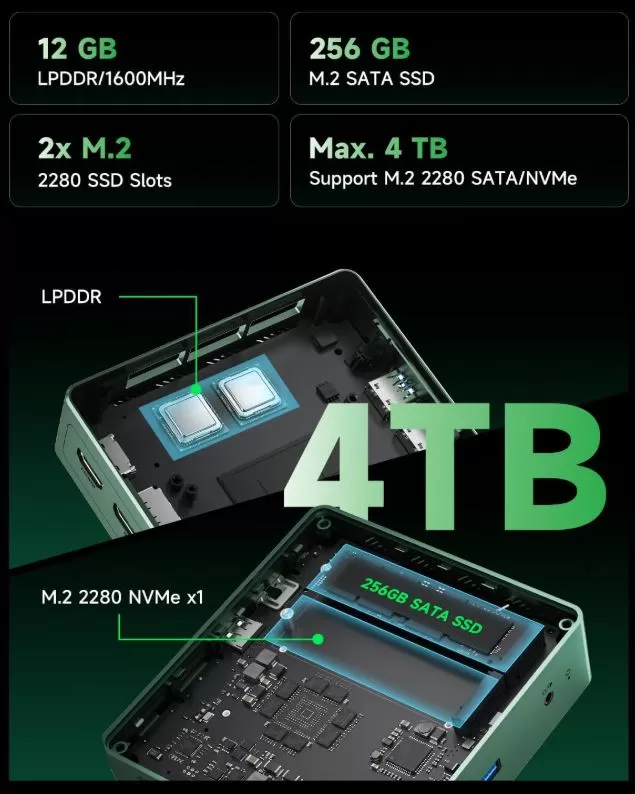
By removing the four lower rubber stops and their corresponding screws, we gain access to the inside of the chassis.
The 12GB of RAM is integrated into the circuit board, so there are no sockets for replacing or upgrading it. If your projects require 16GB or 32GB of memory, you'll want to consider alternatives with traditional SODIMM slots.
In terms of storage, the situation is much more favorable: we find the original 256GB SATA SSD and a fully available secondary M.2 2280 slot that supports NVMe and SATA drives of up to 2TB per bay (4TB maximum combined).
It's a fantastic addition for housing a media library or backups without resorting to external enclosures.
| Slot | Accepted type | Interface | Theoretical maximum speed | Realistic speed |
|---|---|---|---|---|
| Storage occupied by the 256 GB SSD | SATA or NVMe | PCIe 3.0 x4 | ~3,940 MB/s with NVMe | ~3,000-3,500 MB/s with a good NVMe |
| Lower storage slot (free) | NVMe only | PCIe 3.0 x2 | ~1.970 MB/s | ~1,500-1,800 MB/s |
| SSD storage (SATA) | SATA | SATA III | ~600 MB/s | ~500-550 MB/s |
Comparison against direct rivals
| Model | CPU | RAM | SSD | Connectivity | System | Price (€) | Price (US$) | Assessment | Buy |
|---|---|---|---|---|---|---|---|---|---|
| BMAX B6 | Core i3-8109U (2C/4T, 3.6GHz) | 12 GB LPDDR3 | 256 GB SATA + 2nd M.2 slot | WiFi 5, BT 5.0 | Win 11 Pro | €196.00 | $231.99 | 4.1 (152 sold) | AliExpress · Amazon |
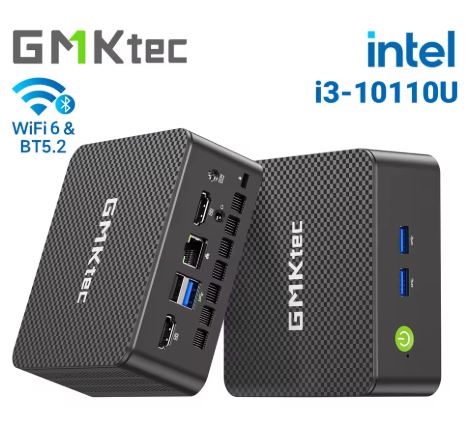
| Xiaman (triple screen) | i7-4510U or i3-6100U | 16 GB DDR3/DDR4 | 512 GB or 1 TB | WiFi 6, BT 5.2 | Win 11 | €187.71 | $210.89 | 5 (39 sold) | AliExpress |
| I AM Y5 | 4th gen Core i3 | 8 GB DDR3 | 128 GB | WiFi, BT 4.2, USB-C, RJ45 | Windows 10 | €86.50 | $97.18 | 4.9 (700+ sold) | AliExpress |
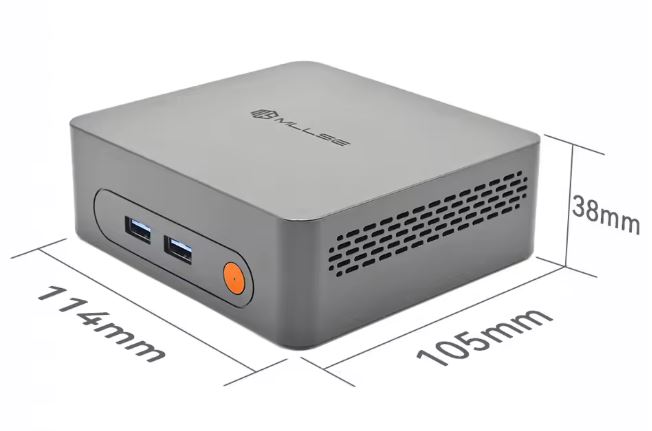
| MLLSE M2 | Core i3-4030U | 8 GB DDR3 | 128 GB | WiFi 5, BT 4.2 | Windows 10 | €67.25 | $75.56 | 5 (1,000+ sold) | AliExpress |
Contrasting opinions within the technology community
The consensus among hardware analysts places the BMAX B6 as a low-compromise solution.
Specialized publications such as Starry Hope give the device an intermediate rating of 2.5 out of 5 stars, praising the inclusion of the second storage slot and its tiny design, but firmly warning that the non-expandable memory and the cessation of regular microcode updates by Intel limit its long-term lifespan.
Meanwhile, home automation communities and home server users report excellent performance of the chassis operating 24/7 with lightweight Linux systems, Docker and Home Assistant, highlighting its stability and the auto-power-on options after power outages configurable directly from the UEFI BIOS.
Frequently Asked Questions (FAQ)
Is it possible to upgrade the RAM in the future?
No, the 12 GB of LPDDR3 memory are fixed directly to the motherboard and there are no additional SODIMM slots.
Can I install two hard drives inside the computer?
Yes, it has the M.2 bay occupied by the original drive and a second free M.2 2280 slot compatible with NVMe and SATA drives up to 2 TB.
Can it be used with Linux distributions?
Absolutely. We've tested distributions like Ubuntu 24.04 LTS and Debian with instant recognition of the Gigabit network card, audio, and Intel graphics acceleration.
Does it come with an activated original Windows license?
The computer includes a valid Windows 11 Pro digital key in the BIOS that is automatically activated after connecting to the Internet during the first startup.
How do I restore the system if Windows fails?
When restarting the mini PC, press and hold the F9 key to enter the BMAX Smart Recovery utility and select automatic factory reset.
In conclusion, who do we recommend this team for?
The BMAX B6 with an Intel Core i3-8109U is a sensible purchase for users who prioritize a very small form factor for schoolwork, light remote work, retail checkout terminals, or as a quiet home server. If your workflow revolves around word processing, video calls, email, and high-definition streaming, it will perform flawlessly.
However, if the selling price is close to that of mini PCs with Intel N100 processors or quad-core or eight-core AMD platforms, you'll want to make the jump to modern architectures with support for DDR4/DDR5 memory and native AV1 decoding.