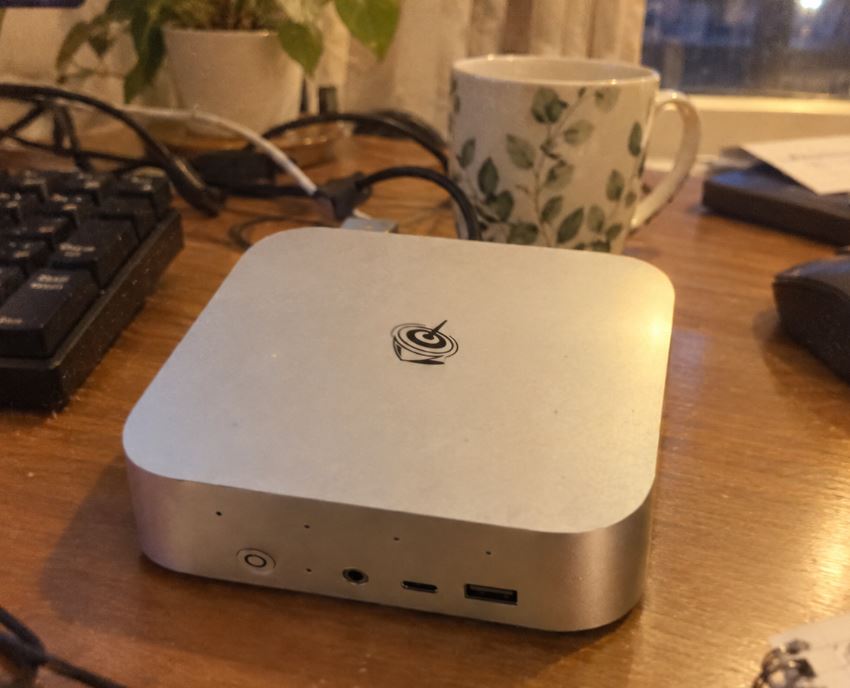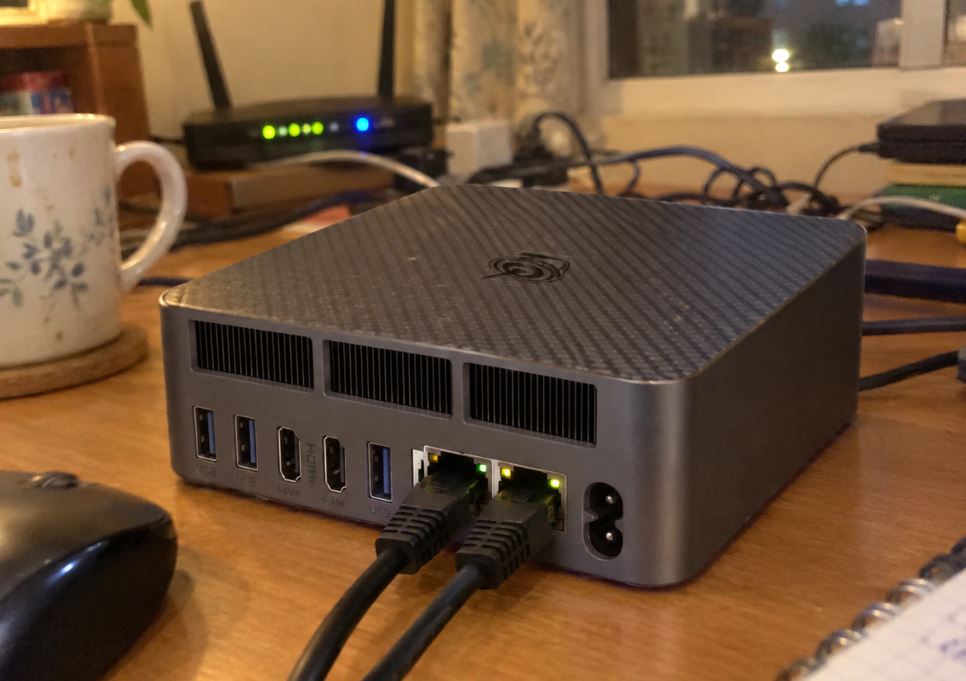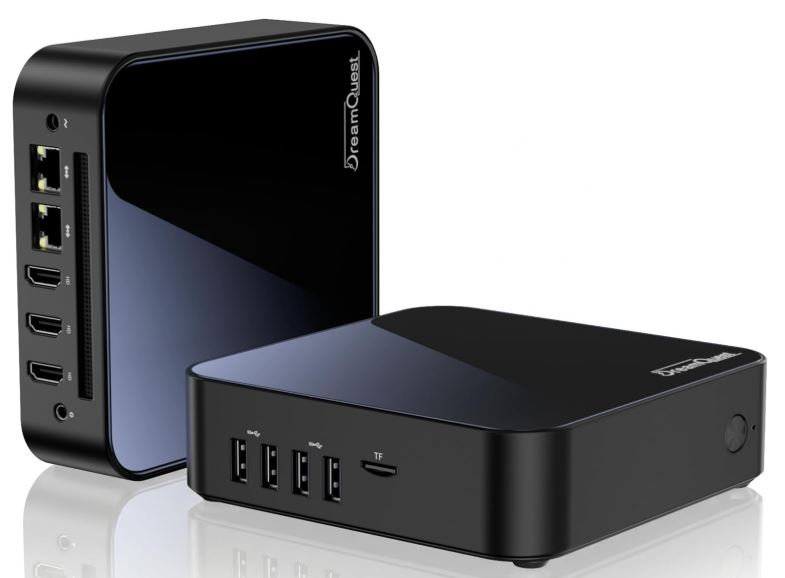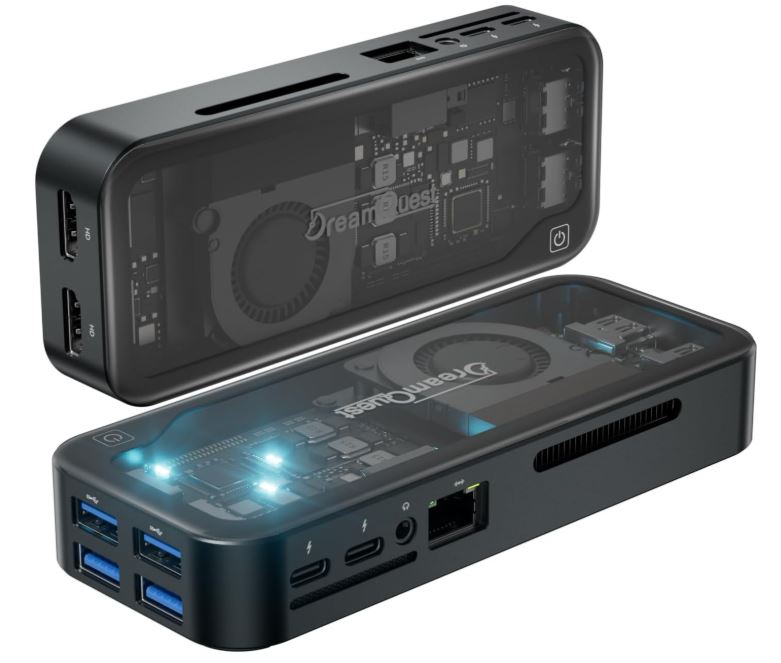
The DreamQuest Mini PC Stick offers an impressive port density for its mere 200 grams, notably featuring two full-size USB-C ports and low power consumption. However, the pre-installed operating system requires a clean software reinstallation, and its internal solid-state drive is limited to SATA bus speeds that are far too slow compared to modern hardware.
It's an attractive purchase for enthusiasts looking for extreme mobility, such as constant travel, without taking up much space, but not recommended for novice users expecting a ready-to-use Windows environment.
-
🟢 Pros:
-
Ultra-compact bar-shaped chassis weighing just 204 grams.
-
Two multifunction USB-C ports with DisplayPort video output and Power Delivery charging.
-
Integrated 12GB LPDDR5 high-speed memory at 4800MHz.
-
Four 10 Gbps USB 3.2 ports on the front.
-
Modern wireless connectivity with Wi-Fi 6 and Bluetooth 5.3.
-
-
🔴 Cons:
-
Unstable factory operating system that requires formatting and installing a clean Linux Mint or Debian system.
-
RAM memory soldered to the motherboard with no options for future expansion.
-
The included M.2 drive operates under the SATA protocol instead of utilizing the NVMe bus.
-
Noisy fan when the processor supports prolonged demanding workloads.
-
→ See DreamQuest Stick mini PC prices on Amazon
Unboxing and contents
The outer packaging is surprisingly small, similar to the packaging of a smartphone.
Upon lifting the lid, we found the microcomputer nestled in a protective mold.
The lower compartment includes a basic instruction manual, a short HDMI cable for easy direct connection to TVs, and a compact wall power adapter terminated in a USB-C connector, confirming the abandonment of proprietary cylindrical pins.
Unlike conventional desktop models, this model does without any metal VESA plate, as its lightness allows it to be placed on the table or attached with technical Velcro.
Mini PC specifications
| Component | Official feature | Tested technical detail |
|---|---|---|
| OEM Model | DreamQuest Mini Plus / DQ05 | Compact bar format motherboard |
| Processor | Intel Alder Lake-N N95 | 4 cores / 4 threads (up to 3.4 GHz, 15W TDP) |
| Graphic card | Intel UHD Graphics | 16 execution units (EUs) at 1.20 GHz |
| RAM | 12 GB LPDDR5 at 4800 MHz | Soldered to motherboard, single channel |
| Storage | M.2 2280 SSD of 256 GB / 512 GB / 1 TB | SATA III connection mode (~490 MB/s) |
| Screen outputs | 2× HDMI 2.0 + 1× USB-C DisplayPort | Support for triple display at 4K and 60 Hz |
| USB-C ports | 2× Multifunction Type C | Data at 10 Gbps, DP video and PD upload |
| USB-A ports | 4× USB 3.2 Gen 2 (10 Gbps) | Grouped in the front header |
| Network connection | 1× RJ45 Gigabit Ethernet (1000 Mbps) | Compatible with Wake on LAN and PXE boot |
| Wireless network | Wi-Fi 6 (802.11ax) + Bluetooth 5.3 | Internal antennas integrated into chassis |
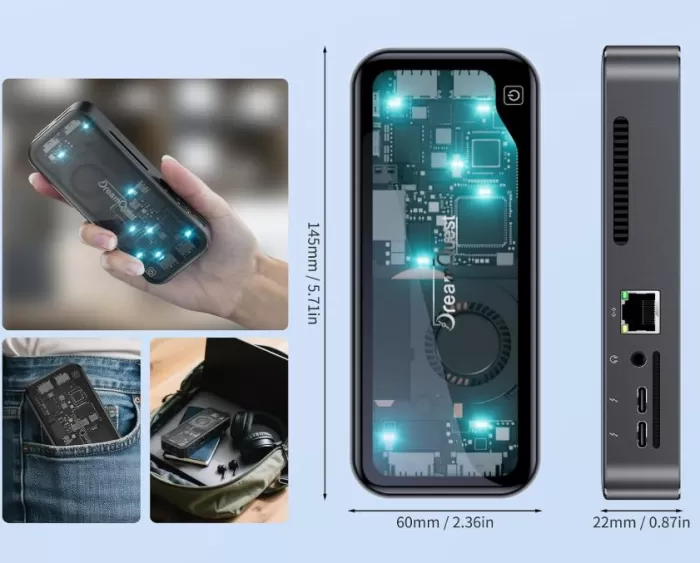
| Dimensions and weight | 145 × 60 × 22 mm / 204 grams | Ultralight pocket profile |
Design and materials
The exterior appearance immediately resembles a high-capacity external battery.
The outer casing is made of durable plastic with rounded edges and a glossy top cover. It feels very light in the hand, which is an advantage for carrying it in a backpack, but a drawback when connecting rigid cables, as the weight of the HDMI or Ethernet cable tends to lift the device off the table. On one side, the physical power button and a tiny hole for resetting the motherboard's CMOS memory in case of a boot freeze are prominent features.
Display and multimedia capabilities
The graphics output easily meets the needs of a multimedia center connected to the television.
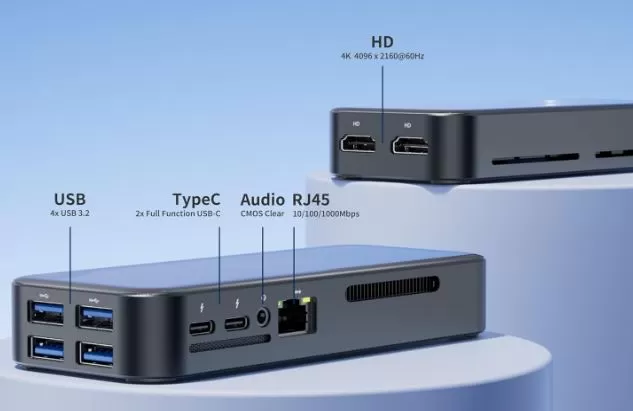
Through its two HDMI ports and USB-C connector compatible with DisplayPort, it allows you to manage up to three independent monitors with ultra-high resolution at sixty frames per second.
Intel's multimedia engine effortlessly decodes 4K resolution video encoded in AV1 or HEVC on platforms like YouTube or local servers.
The combined 3.5mm analog audio jack provides a clean signal for headphones, although if you're going to use it as a living room player, the most practical thing to do is to transmit the multichannel audio directly via the HDMI cable.
Connectivity and available ports
The port selection is simply spectacular for such a narrow body.
On the front we find four traditional-sized USB connectors with a speed of ten gigabits per second, ideal for external drives and peripherals.
On the side are the two reversible USB-C ports; it is essential to remember that one of them must be permanently occupied by the power cable, leaving the second one free for portable screens or fast drives.
The presence of a Gigabit RJ45 network connector ensures stable transfers without relying on the wireless signal.
Processor performance
The heart of the team rests on the efficient quad-core Intel N95 chip.
Under lightweight distributions like Linux Mint or Ubuntu, the processor offers an immediate response when opening office applications, browsing with dozens of heavy tabs, or compiling code in the terminal.
The 12GB of LPDDR5 memory ensures consistently smooth multitasking, surpassing older models that used slower DDR4 modules. However, if heavy video editing or complex 3D modeling is required, the processor's four threads quickly reach their limit.
Storage and network testing
When running speed tests on the factory-installed drive, sequential read speeds reached 492 MB/s and write speeds reached 391 MB/s. Although the physical M.2 slot supports NVMe drives, the motherboard controller is configured in SATA mode to conserve traces.
Meanwhile, the Gigabit network card saturates the line, achieving continuous transfers of 116 MB/s, while the Wi-Fi 6 module maintains stable links and low latency when paired with modern routers.
→ View Prices and Options for the DreamQuest Stick Mini PC on Amazon
Sound and Temperature
The thermal challenge in a chassis only twenty-two millimeters thick is considerable.
During office tasks and video playback, the internal fan keeps noise levels between 30 dB and 35 dB, behaving like an imperceptible whisper in a typical work environment. However, when the CPU is under sustained heavy load, internal temperatures reach around 70 °C and the fan speeds up, emitting a noticeable high-pitched whine.
In terms of electrical performance, standby power consumption is a surprising 6W, rising to a ceiling of just 20W under severe stress.
Expansion options and software
Possibilities for physical expansion
The ultra-compact format drastically limits the upgrade possibilities:
-
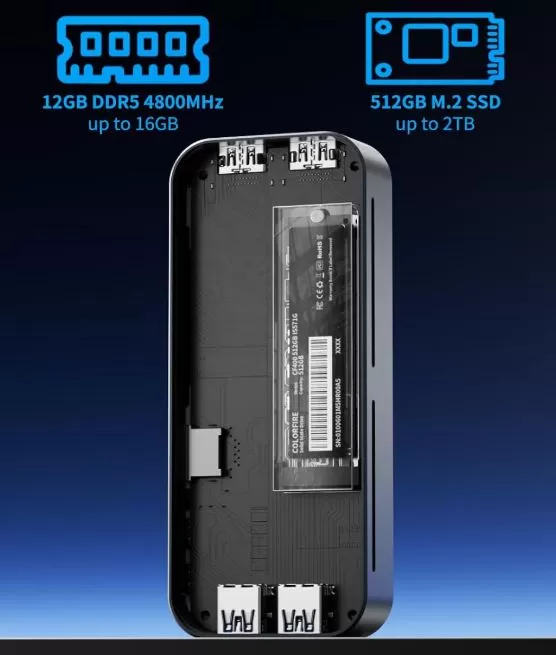
RAM: It is completely fixed. The 12 GB of LPDDR5 memory are soldered directly to the motherboard and there is no slot to add more.
-
Disk replacement: You can remove the screw from the motherboard to replace the stock drive with a higher capacity M.2 NVMe SSD up to a limit of 2 TB.
-
Secondary drives: There is no physical space to accommodate mechanical bays or 2.5-inch SATA drives; any additional storage must be connected via external drives.
The software section
The pre-installed operating system is the most controversial aspect of this computer.
Out of the box, it includes an Asian modification called DreamQuest OS, which lacks recovery options and has incomplete translations. Furthermore, the UEFI BIOS comes completely unlocked but without security keys, causing standard Windows 11 installers to block the installation unless security settings are manually configured.
The unanimous recommendation is to download a clean image of Linux Mint or Debian and format the disk from the first boot to enjoy a stable machine.
Video games and retro emulation
Gaming performance
The integrated Intel UHD graphics card with sixteen execution units imposes clear limits.
Modern 3D video games are unplayable on this device. Simple competitive titles like League of Legends or Valorant can be run at playable frame rates by reducing the resolution to 720p and adjusting the visual details to the minimum. Lightweight 2D games and indie platformers run perfectly smoothly.
Emulation of classic consoles
The emulation performance compensates for the shortcomings in modern games for retro enthusiasts:
-
8 and 16 bit systems: Perfect emulation on consoles like NES, Super Nintendo, Mega Drive and Game Boy.
-
32 and 64 bit generation: PlayStation 1 and Nintendo 64 run with internal resolution scaling without frame drops.
-
Advanced handhelds: PSP and Nintendo DS run at full speed on virtually their entire catalog.
-
Emulation limit: Consoles like PlayStation 2 or GameCube exhibit noticeable frame rate drops in graphically demanding titles.
Verified buyer reviews
Real user experiences in European stores confirm the dual nature of this microcomputer:
-
Key strengths: Experienced users praise its USB-C connectivity, the responsiveness provided by the 12GB of RAM, and its outstanding performance as a small server for home automation. Buyers who replaced the factory operating system with Linux Mint highlight that the device transforms into a quiet and fast workstation.
-
Common criticisms and complaints: Several buyers returned the computer, annoyed by the presence of DreamQuest OS with residual Chinese text and the inability to directly install Windows 11. Other customers criticized the intensity of the internal LED lights visible in the dark and the fan whirring when the processor reaches maximum power.
Comparison of Stick-Type Mini PCs
| Model | Processor | RAM | Storage | Ports and interfaces | Dimensions and weight | Price (EUR / USD) | Purchase link |
|---|---|---|---|---|---|---|---|
| DreamQuest Stick 1TB | Intel N95 (4C/4T up to 3.4 GHz) | 12 GB LPDDR5 (4800 MHz) | 256 GB M.2 2280 SSD (SATA mode <500Gbps) | 2× full USB-C (10 Gbps/PD), 4× USB 3.2, 2× HDMI, 1× Gigabit LAN | 145 × 60 × 22 mm / 204 g | $240 USD | View on Amazon |
| MeLE PCG02 Pro | Intel N100 (4C/4T up to 3.4 GHz) | 8 GB LPDDR4x | 256 GB eMMC 5.1 | 1× USB-C (PD 3.0), 2× USB 3.2 (10 Gbps), 2× HDMI, 1× Gigabit LAN, MicroSD | 146 × 61 × 20 mm / 182 g | €439.00 / ~$475 USD | View on AliExpress |
| Morefine M1K | Intel Pentium Silver N5030 (4C/4T up to 3.1 GHz) | 8 GB LPDDR4 | 256 GB eMMC / SSD | 1× HDMI (integrated male), 2× USB 3.0, 1× Micro USB (DC), MicroSD, WiFi 5 | 138 × 45 × 15 mm / 83 g | €281.39 / ~$305 USD | View on AliExpress |
| Chenxin M1K | Intel Celeron J4125 (4C/4T up to 2.7 GHz) | 8 GB LPDDR4 | 128 GB eMMC | 1× HDMI (integrated male), 2× USB 3.0, 1× Micro USB (DC), MicroSD, WiFi 5 | 135 × 45 × 15 mm / 84 g | €235.99 / ~$255 USD | View on AliExpress |
-
If the absolute priority is total silence (0 dB) and continuous industrial operation, the MeLE PCG02 Pro is the industry benchmark.
-
If you're looking for the best power/storage ratio in a pocket-sized device, the 1TB DreamQuest Stick is the undisputed winner thanks to its Alder Lake processor, 12GB of DDR5 memory, and massive storage capacity, all for €353.82.
-
M1K models based on J4125 or N5030 would only make sense if their prices dropped drastically, as at over €230 they have become completely outdated compared to Intel's new platform.
Frequently Asked Questions
Does it come with Windows 11 pre-installed and activated?
No, this pocket-sized model comes with a Linux-based distribution and requires BIOS technical knowledge to install Windows.
Can you power your computer with a mobile phone charger?
Yes, provided the power adapter is compatible with Power Delivery and delivers at least 30 watts of continuous power.
Does it support faster NVMe solid-state drives?
The physical M.2 slot supports NVMe drives, but the motherboard circuitry will limit transfer rates to the equivalent bandwidth of SATA.
Conclusion and alternatives
The DreamQuest Mini PC Stick (DQ05) is a brilliant device in its hardware design but penalized by the factory software.
Its pocket-sized form factor, 12GB of RAM, and two USB-C ports make it an ideal machine for technicians, system administrators, and users looking for a portable Linux terminal for under €300. If you don't want technical complications and are looking for a ready-to-use family computer with Windows 11, it's preferable to opt for the traditional square model or upgrade to a mini PC with a Ryzen 7 processor on Amazon for more demanding tasks.