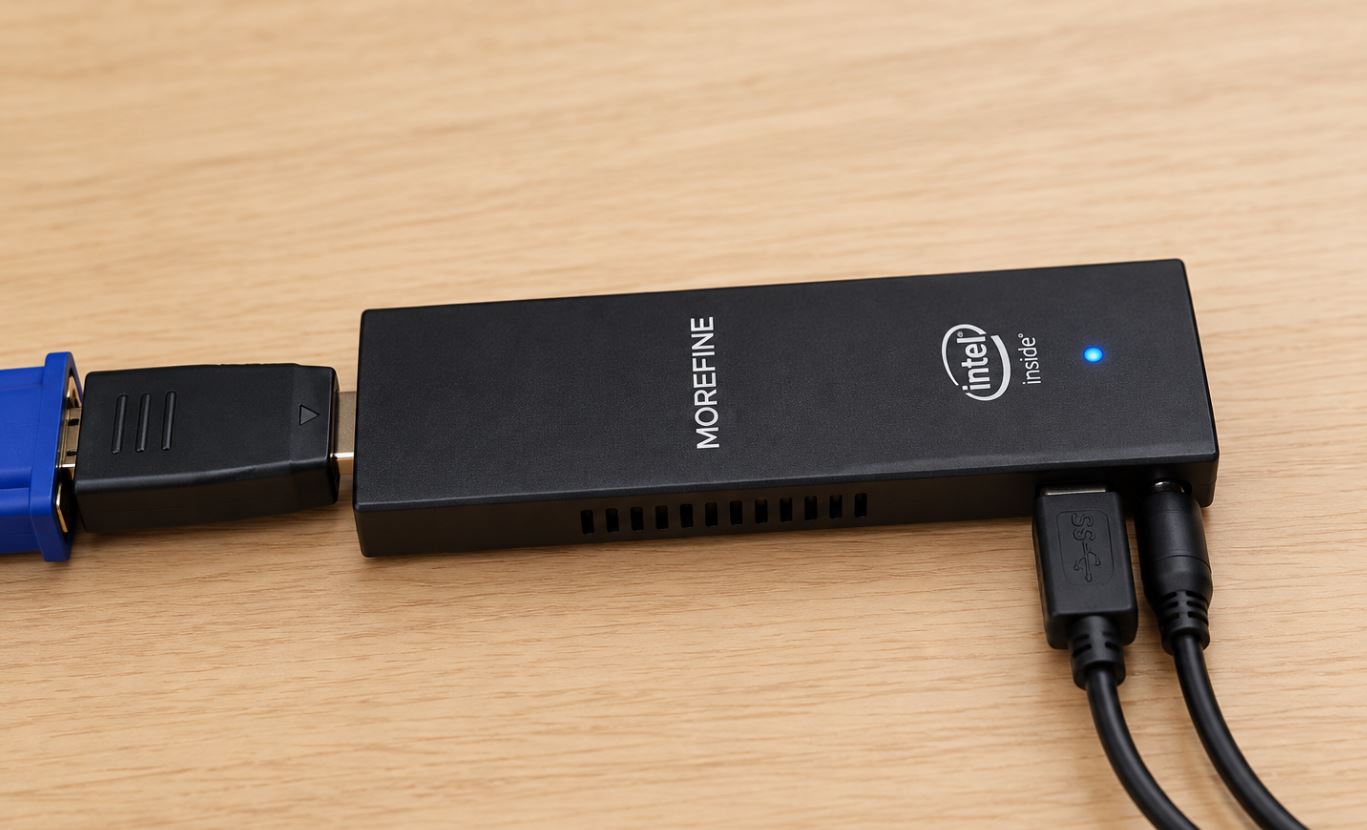
The MOREFINE M1K is a pocket-sized computer designed to connect directly to any screen or television via HDMI.
-
Pros:
-
📏 Tiny size (83g) with direct HDMI connection without cumbersome cables.
-
🔌 Includes 2 full-size USB 3.0 ports and a Micro SD card reader.
-
⚡ Ridiculously low power consumption of less than 12W at full load.
-
-
Cons:
-
❌ eMMC 5.1 storage is slower than a traditional NVMe SSD.
-
🚫 Soldered RAM and storage with no possibility of internal expansion.
-
🌡️ High temperatures under continuous stress due to its ultra-compact chassis.
Quick conclusion: A versatile and extremely convenient device for those looking to carry a complete Windows environment in their pocket for hotels, meetings, or digital signage, as long as heavy editing or modern 3D games are not required.
-
🛒 See price and buy the MOREFINE M1K Mini PC Stick
Unboxing and box contents
The MOREFINE M1K packaging is austere and functional, designed to make the most of every centimeter:
-
🖥️ MOREFINE M1K Mini PC Stick with protective cover for the HDMI plug.
-
🔌 12V power adapter with round plug.
-
📺 HDMI male-female extension cable, an essential accessory when the TV ports are attached to the chassis or the wall.
-
📖 Quick start guide with step-by-step diagrams.
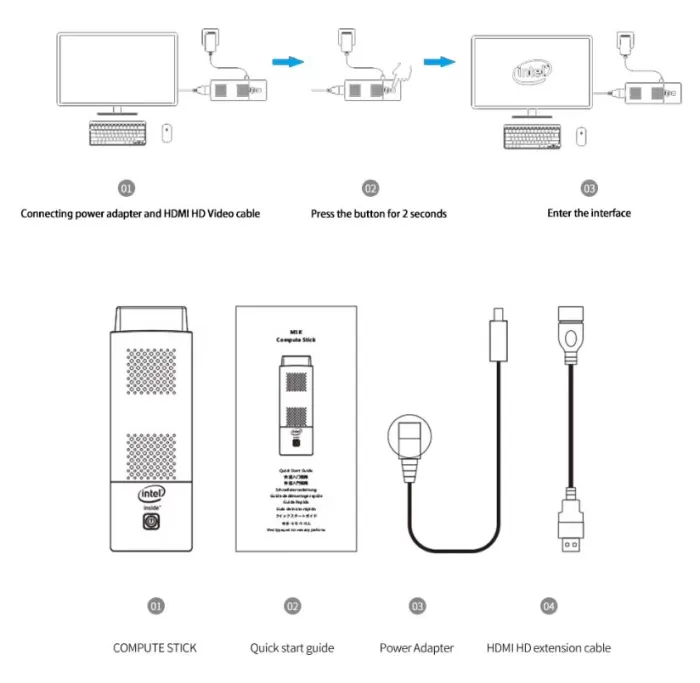
Technical specifications
| Parameter | Technical Specification |
|---|---|
| Make and model | MOREFINE M1K Compute Stick |
| Processor (Options) | - Intel Pentium Silver N5030: 4 cores / 4 threads, 1.10 GHz up to 3.10 GHz burst, 4 MB cache, TDP 6 W - Intel Celeron J4125: 4 cores / 4 threads, 2.00 GHz up to 2.70 GHz burst, 4 MB cache, TDP 10 W - Intel Pentium Silver J5005: 4 cores / 4 threads, 1.50 GHz up to 2.80 GHz burst, 4 MB cache, TDP 10 W |
| Integrated graphics | - Intel UHD Graphics 605 (18 EUs, up to 750 MHz) in N5030 and J5005 versions - Intel UHD Graphics 600 (12 EUs, up to 750 MHz) in Celeron J4125 version |
| RAM | 8 GB LPDDR4 (soldered on board, single channel configuration / not expandable) |
| Internal storage | 128 GB or 256 GB integrated eMMC 5.1 (soldered on board) |
| Storage expansion | Micro SD card slot (up to 256 GB / 512 GB) |
| Video output | Integrated HDMI 2.0 male connector (maximum resolution 4K / 3840 × 2160 at 60 Hz) |
| Wireless connectivity | Dual-band Wi-Fi 5 (Intel Dual Band Wireless-AC 7265, 2.4 GHz/5 GHz) + Bluetooth 5.1 |
| Physical ports | - 2x USB 3.0 Type-A (5 Gbps) - 1x Micro SD slot - 1x DC power input (dedicated cylindrical power pin) - 1x HDMI male plug protected with cap |
| Audio output | Integrated digital audio via HDMI output (no 3.5 mm jack) |
| Power supply | External DC 12V power adapter (EU, US or UK plugs depending on region) |
| Refrigeration | Active (internal copper heatsink assisted by a microfan with top and side ventilation slots) |
| Dimensions | 138 mm (Length with cap) × 45 mm (Width) × 15 mm (Thickness) |
| Weight | 83 grams |
| Operating system | Windows 11 Pro / Windows 10 Pro (pre-activated) and native compatibility with Linux distributions |
Design and construction quality
The MOREFINE M1K measures exactly 138 mm long by 45 mm wide and 15 mm thick, weighing just 83 grams, dimensions smaller than any contemporary smartphone.
The chassis combines dense ABS plastic with alloy sections and a sober matte black finish. It feels solid in hand, with no strange creaks or rattles.
The top features two large honeycomb perforated areas to expel the hot air pushed by its internal micro-fan. The front includes a physical power button with a firm feel and a blue status LED.
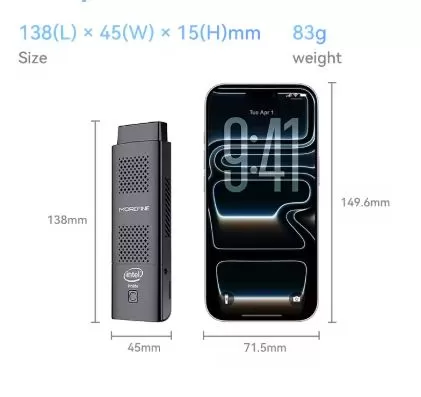
Screen and multimedia
The stick does not integrate its own panel; its male HDMI 2.0 connector delivers smooth 4K resolutions at 60 Hz on any external display.
-
4K Streaming: Play video on YouTube, Netflix, and Prime Video in 1080p and 4K with a constant frame rate thanks to the Intel QuickSync hardware decoder for h.264 and HEVC/H.265 codecs.
-
Audio: It is transmitted cleanly via the HDMI output to the TV or monitor speakers. Since there is no direct 3.5 mm jack, Bluetooth or a USB sound card is required to listen to music with headphones.
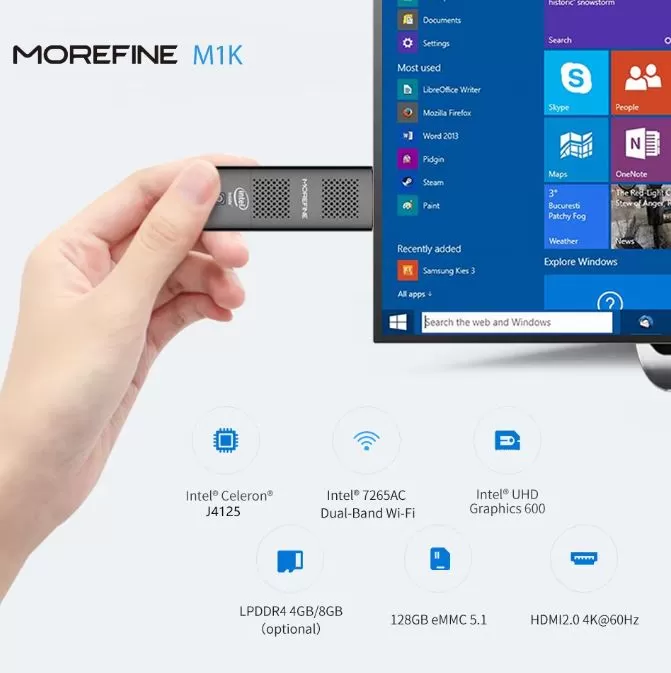
Performance and software
Overall fluency and experience in Windows 11
The stick's behavior varies subtly depending on the processor version installed:
-
With the Intel Pentium Silver N5030: Thanks to its maximum turbo frequency of 3.10 GHz, the system offers a fast response in everyday single-threaded tasks, such as opening browsers, switching between explorer folders, or running lightweight office clients.
-
With the Intel Celeron J4125: Its 2.00 GHz base frequency maintains very linear and predictable behavior in continuous tasks such as word processing, medium-complexity spreadsheets, and video calls.
The 8 GB of LPDDR4 RAM is the minimum required for Windows 11 to run smoothly. In a typical office scenario (browser with 8–10 tabs open, Word document, Spotify, and messaging client running in the background), memory usage remains between 60% and 75%, without causing forced closures or interface freezes.
Internal speeds: The eMMC factor 5.1
Although some commercial catalogs refer to the storage as a "high-speed SSD," the internal drive is a soldered eMMC 5.1 flash memory chip. Synthetic performance tests using CrystalDiskMark 8 show the following transfer rates:
| Disk parameter | Rate obtained | Performance context |
|---|
| Disk parameter | Rate obtained | Performance context |
|---|---|---|
| Sequential reading (SEQ1M Q8T1) | ~284 MB/s | Almost twice as fast as a traditional 2.5" SATA mechanical hard drive |
| Sequential writing (SEQ1M Q8T1) | ~138 MB/s | Sufficient for storing documents and downloads, but modest for moving large files. |
| Random read (RND4K Q1T1) | ~24 MB/s | It dictates the response time when loading small system libraries and components. |
| Random write (RND4K Q1T1) | ~38 MB/s | Bottleneck during intensive installation processes. |
Impact of updates and optimization recommendations
The eMMC 5.1 storage is the most modest component of the system and marks the moments of greatest slowness in the computer:
-
Windows Update Management: During the download and installation of monthly cumulative patches, eMMC disk usage reaches 100%, which may temporarily slow down application launches. It is recommended to schedule updates outside of business hours.
-
Visual performance adjustments: Turning off Windows 11 transparencies ( Settings > Accessibility > Visual effects ) and disabling secondary telemetry services frees up CPU cycles and reduces constant accesses to flash memory.
-
Linux/ChromeOS Flex alternative: If you're looking for superior agility, the M1K hardware offers native support for lightweight distributions like Lubuntu, Debian, or ChromeOS Flex, which drastically reduce RAM usage and take full advantage of the eMMC 5.1 chip's bandwidth.
🛒 See price and buy the MOREFINE M1K Mini PC Stick
Energy consumption and cables
The MOREFINE M1K stands out for its exceptionally low power consumption, positioning itself as an ideal alternative for equipment that needs to remain switched on continuously:
-
At idle : It ranges between just 3.5 W and 4.5 W (the Pentium N5030 version being the most austere thanks to its base TDP of 6 W).
-
Office use and streaming: It stabilizes around 6 W – 8 W.
-
Maximum sustained load (CPU + GPU at 100%): Registers peaks of 10W to 12W in the model with Celeron J4125, and 8W to 10W in the variant with Pentium N5030.
Power is supplied via an external 12V power adapter with a dedicated DC jack, not via USB. This means it cannot be powered through the TV's USB ports (which only provide 5V), so it will always require a nearby power outlet. On the plus side, the adapter cable is thin and flexible, allowing it to be easily hidden behind the monitor to keep your desk clutter-free.
Temperature and noise (Actual thermal behavior)
Dissipating the heat of a quad-core processor within an 83-gram, 15-mm-thick chassis demands a strict balance between airflow and acoustics:
-
Idle temperatures: The CPU stays between 40°C and 46°C (with a 3–4°C advantage for the N5030). In this state, the microfan spins at low speeds and is virtually imperceptible from a meter away.
-
Temperatures under heavy load (Cinebench / Stress Test): The core reaches peaks between 78 °C and 83 °C. Upon exceeding 70 °C, the internal turbine accelerates: it does not become noisy in raw decibels (~34-36 dBA), but generates a slight high-pitched whistling sound typical of high-speed miniature fans.
-
Thermal Throttling : After 15–20 minutes of continuous 100% synthetic stress, the firmware reduces burst frequencies towards the base clock to stabilize the temperature below 80°C. This behavior prevents overheating and ensures system stability, without causing crashes or unintentional restarts.
Connectivity and extras
Despite its sleek profile, the MOREFINE M1K offers practical and sufficient connectivity for everyday use:
-
USB 3.0 Type-A Ports: It features two full-size USB 3.0 ports, allowing you to simultaneously connect a wireless keyboard/mouse receiver and a USB flash drive without needing external hubs.
(Reviewer's tip: As is often the case with such compact chassis, connecting high-traffic USB 3.0 external hard drives may cause slight, occasional electromagnetic interference in the 2.4 GHz band; if you notice slight cursor jerks with a wireless mouse, it's preferable to use peripherals directly connected via Bluetooth or a small, flexible USB extender.) -
Wireless network: Its Intel Dual Band Wireless-AC 7265 chip provides Wi-Fi 5 (2.4 GHz and 5 GHz) and Bluetooth 4.2 connectivity, achieving stable transfers and smooth downloads at over 300 Mbps on home fiber networks.
-
Audio and video output: The image and sound signals are sent together via the HDMI 2.0 male connector. The device does not have a 3.5 mm audio jack, so if connected to a monitor without built-in speakers, the sound must be routed through Bluetooth headphones/speakers or a USB audio adapter.
-
Notable omissions: It does not include a native RJ45 Ethernet network port (although it supports USB to Gigabit LAN adapters), a fingerprint reader, an NFC chip, or IP certification against dust or liquids.
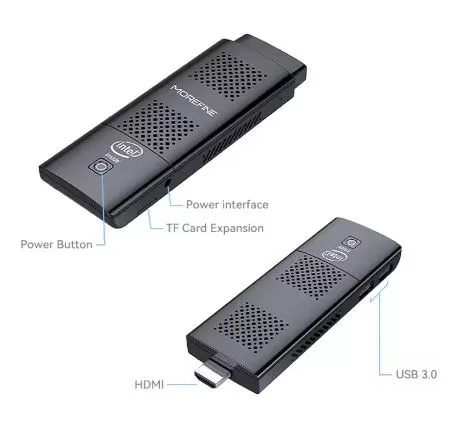
Expansion and upgrades
Physical upgrade possibilities are 100% limited by the ultraportable dongle format:
-
RAM: The system includes 8 GB of LPDDR4 RAM soldered directly to the motherboard in a single-channel configuration. It does not have SODIMM slots, so it is not possible to upgrade the memory to 16 GB.
-
Internal storage: The eMMC 5.1 flash memory is soldered onto the printed circuit board ; it does not have 2.5" SATA bays or internal M.2 NVMe/SATA slots due to the lack of physical space in the chassis.
-
External expansion options:
-
Micro SD card slot: The side slot supports MicroSDXC cards up to 512GB (A1 or A2 certified models are recommended for smooth file reading). You can equip it with a high-speed Micro SD card from AliExpress to store documents, photos, and emulators without overloading the main drive.
-
Via USB 3.0: If you need faster transfer speeds for massive backups, you can connect a portable external USB SSD from AliExpress, taking full advantage of the theoretical 5 Gbps of its Type-A ports.
-
Comparison with direct competitors
| Model | Processor | RAM | Storage | Ports and interfaces | Dimensions and weight | Price (EUR / USD) | Purchase link |
|---|---|---|---|---|---|---|---|
| Morefine M1K | Intel Pentium Silver N5030 (4C/4T up to 3.1 GHz) | 8 GB LPDDR4 | 256 GB eMMC / SSD | 1× HDMI (integrated male), 2× USB 3.0, 1× Micro USB (DC), MicroSD, WiFi 5 | 138 × 45 × 15 mm / 83 g | €281.39 / ~$305 USD | View on AliExpress |
| DreamQuest Stick 1TB | Intel N95 (4C/4T up to 3.4 GHz) | 12 GB LPDDR5 (4800 MHz) | 1 TB M.2 2280 SSD (SATA mode) | 2× full USB-C (10 Gbps/PD), 4× USB 3.2, 2× HDMI, 1× Gigabit LAN | 145 × 60 × 22 mm / 204 g | €353.82 / ~$385 USD | View on Amazon |
| MeLE PCG02 Pro | Intel N100 (4C/4T up to 3.4 GHz) | 8 GB LPDDR4x | 256 GB eMMC 5.1 | 1× USB-C (PD 3.0), 2× USB 3.2 (10 Gbps), 2× HDMI, 1× Gigabit LAN, MicroSD | 146 × 61 × 20 mm / 182 g | €439.00 / ~$475 USD | View on AliExpress |
| Chenxin M1K | Intel Celeron J4125 (4C/4T up to 2.7 GHz) | 8 GB LPDDR4 | 128 GB eMMC | 1× HDMI (integrated male), 2× USB 3.0, 1× Micro USB (DC), MicroSD, WiFi 5 | 135 × 45 × 15 mm / 84 g | €235.99 / ~$255 USD | View in |
Reviews on well-known websites and in the community
Users and editors of forums specializing in mini PCs highlight key points about this chassis:
-
Convenience of transport: Shoppers on retail platforms unanimously appreciate that it can be stored in a shirt pocket or backpack along with a miniature wireless keyboard to take the workstation to second homes or work remotely in hotels.
-
Use in commercial signage: In commercial integration forums, it is a highly praised model for playing video loops in shop windows and bar screens due to its auto power-on function after a power outage ( Auto Power On in BIOS).
-
Criticism of the eMMC format: Enthusiasts frequently point out that they would have preferred an internal M.2 2242 slot instead of eMMC to install faster drives, although they acknowledge that the internal space of the stick made it unfeasible.
Technical tests and benchmarks
CPU performance: Cinebench R23 and Geekbench 5
| Synthetic test | Celeron J4125 | Pentium Silver N5030 | Technical interpretation |
|---|---|---|---|
| Cinebench R23 (Single-Core) | ~425 pts | ~490 pts | Modest single-core performance focused on low power consumption. |
| Cinebench R23 (Multi-Core) | 1,420 pts | 1,360 pts | Sufficient fluency for office work without continuous freezes. |
| Geekbench 5 (Single-Core) | 440 pts | 495 pts | The N5030 takes the lead thanks to its turbo boost of up to 3.10 GHz. |
| Geekbench 5 (Multi-Core) | 1,390 pts | 1,340 pts | Joint work of the 4 cores to maintain system stability. |
-
Single-core performance: It scores between 440 and 495 points on Geekbench 5. This is a modest score typical of 6W to 10W chips (for reference, current desktop processors exceed 1,600 points). In practice, this translates to a slow but stable opening of demanding programs.
-
Multi-core performance: Approaching 1,400 points, the 4 cores cooperate effectively to avoid crashes when simultaneously keeping the browser open with several tabs, office documents, and multimedia players.
Storage speed: CrystalDiskMark 8
-
Sequential read: 284 MB/s (virtually doubles the rate of a mechanical SATA hard drive).
-
Sequential write speed: 138 MB/s (sufficient for everyday downloads, but modest when moving files of many gigabytes).
-
Random read (RND4K Q1T1): 24.5 MB/s, a figure that defines the response times when loading small libraries and operating system dependencies.
4K Media Playback Test
We subjected the integrated hardware decoder (Intel QuickSync) to the playback of video sequences in 4K Ultra HD resolution (3840 × 2160 at 60 fps) encoded in HEVC/H.265 and VP9 in full screen:
-
Result: 0 dropped frames.
-
CPU Load: Processor usage remained stable below 20%, offloading virtually all decompression work to the integrated GPU (Intel UHD 600/605). This ensures a smooth multimedia experience on both work monitors and living room displays.
Gaming and emulation
The M1K is not a computer geared towards next-generation video games, but it offers interesting possibilities in the classic realm:
-
Classic and indie PC games: Two-dimensional titles such as Stardew Valley, Terraria, Celeste or classics such as Age of Empires II (HD Edition) run at a stable 60 fps.
-
Retro emulation: Its processor handles classic console emulators with ease:
-
8 and 16 bits (NES, SNES, Mega Drive): 100% speed.
-
PlayStation 1 and Nintendo 64: Native resolution and light upscaling at 60 fps without stuttering.
-
PSP: Less demanding titles run at 1x/2x resolution; complex games like God of War suffer from frame rate drops.
-
Frequently Asked Questions (FAQ)
Can it be powered via the TV's USB port?
No. It requires its dedicated 12V power adapter plugged into the mains, as the standard USB ports on displays only deliver 5V (usually 0.5A - 1A), which is insufficient power to run the motherboard and processor.
Does it support automatic restart after a power outage?
Yes. In the BIOS settings (accessed by pressing Delete or F7 at startup) you can activate the Auto Power On / AC Back function, ideal for unattended digital signage.
Can Linux be installed on it?
Yes. Lightweight distributions like Ubuntu Server, Lubuntu, or Debian work correctly, recognizing network and audio hardware without driver issues.
Final conclusion
The MOREFINE M1K excels at its purpose: offering a fully functional, ultra-low-power Windows 11 desktop computer in a chassis barely larger than a lighter. It's the ideal choice for users who need maximum portability without cumbersome HDMI cables, for setting up a silent home entertainment system, or for deploying commercial signage displays.
If your priority isn't the direct-connect stick format and you prefer greater internal memory and storage expansion capacity, you should consider traditional desktop models like the mini PCs with AMD Ryzen 7 processors on Amazon.
Where to buy
You can check product availability, processor options, and current promotions via the following direct link:
🛒 See price and buy the MOREFINE M1K Mini PC Stick on AliExpress