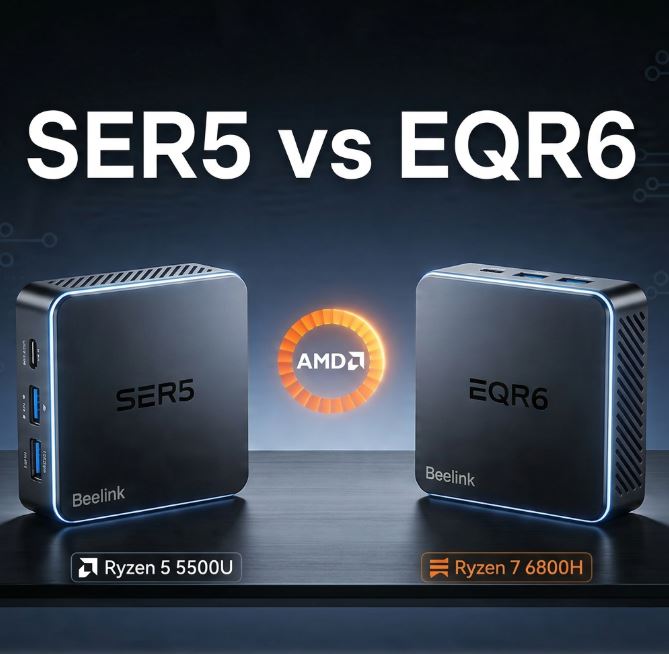
If you're looking for a great value AMD mini PC in 2026, the Beelink SER5 and Beelink EQR6 are two of the most popular options on the market.
Although both share a brand and compact philosophy, they are very different in architecture, GPU, RAM and performance.
In this comparison we explain everything you need to know to make the right decision.
What sets them apart at first glance?
The Beelink SER5 features an AMD Ryzen 5 5500U processor based on Zen 3 architecture (7 nm), while the Beelink EQR6 takes a generational leap with options of Ryzen 5 6600U or Ryzen 7 6800H, based on Zen 3+ (6 nm).
The most noticeable difference in day-to-day use is in the integrated GPU and the type of RAM: the SER5 uses DDR4, while the EQR6 debuts LPDDR5 in Dual Channel, which directly impacts graphics performance.
- View Prices and Availability of the Beelink SER5 mini PC.
- View Prices and Availability of the Beelink EQR6 mini PC.
Technical Specifications
| Feature | Beelink SER5 (5500U) | Beelink EQR6 (6600U) | Beelink EQR6 (6800H) |
|---|---|---|---|
| Processor | Ryzen 5 5500U (6c/12t, 4,0 GHz) | Ryzen 5 6600U (6c/12t, 4,5 GHz) | Ryzen 7 6800H (8c/16t, 4,7 GHz) |
| Architecture | It was 3 · 7 nm | Zen 3+ · 6 nm | Zen 3+ · 6 nm |
| Integrated GPU | Radeon RX Vega 6 (384 shaders) | Radeon 660M (6 CU, RDNA2) | Radeon 680M (12 CU, RDNA2) |
| RAM | 16 GB DDR4 / 32 GB DDR4 | 24 GB LPDDR5 Dual Ch. | 24 GB LPDDR5 Dual Ch. |
| Storage | 500GB NVMe PCIe 3.0 | 500GB NVMe PCIe 4.0 | 500GB NVMe PCIe 4.0 |
| SSD slots | 1× M.2 + 1× SATA 2.5" | 2× M.2 PCIe 4.0 | 2× M.2 PCIe 4.0 |
| Video outputs | 2× HDMI 2.0 + 1× DP (triple 4K) | 2× HDMI 2.0 (doble 4K) | 2× HDMI 2.0 (doble 4K) |
| WiFi | WiFi 6 (Intel AX200) | WiFi 6 (Intel AX-101) | WiFi 6 (Intel AX-101) |
| Ethernet | 1× Gigabit LAN | 2× Gigabit LAN (Dual LAN) | 2× Gigabit LAN (Dual LAN) |
| Fountain | External (65 W) | Integrated into chassis | Integrated into chassis |
| TDP configurable | 15–45 W | 15–28 W | 35–54 W |
| SO | Windows 11 Pro | Windows 11 Pro | Windows 11 Pro |
| Dimensions | 126 × 113 × 42 mm | 126 × 113 × 45,5 mm | 126 × 113 × 45,5 mm |
| Current price | €479 (16GB) / €589 (32GB) | 536 € | 557 € |
CPU Performance: Real Benchmarks
In Cinebench R23:
- The SER5's Ryzen 5 5500U processor achieves 7,667 multi-core points and 1,260 single-core points.
- The EQR6 with Ryzen 5 6600U rises to ~8,500 pts multi / ~1,200 pts single.
- The Ryzen 7 6800H processor (Beelink EQR6) scales remarkably to ~11,500 pts multi / ~1,350 pts single.
In practice, the SER5 handles office multitasking, simultaneous video conferencing, and photo editing in Lightroom without problems.
The EQR6 with 6800H, thanks to its 8 cores and 54W TDP, makes a real difference in exporting 1080p video from DaVinci Resolve or Premiere, being noticeably faster under sustained loads.
GPUs and Gaming: The Key Difference
This is where the gap becomes most evident.
The SER5's Radeon RX Vega 6 is a previous generation (GCN) GPU, with only 384 shaders, suitable for esports gaming at 60-75 FPS on medium settings.
The Radeon 660M (RDNA2, EQR6 6600U) improves on this, but the real star is the Radeon 680M (12 CU RDNA2) of the EQR6 6800H: in CS2 at 1080p medium it achieves a stable 85–100 FPS, and in GTA V at medium settings it shows no signs of slowing down.
In 3DMark Time Spy, the difference is striking:
-
Vega 6 (SER5): ~3,050 points in Fire Strike Graphics
-
Radeon 660M (EQR6 6600U): ~1.300–1.500 puntos Time Spy
-
Radeon 680M (EQR6 6800H): ~2.200–2.600 puntos Time Spy
For retro emulation, both are more than sufficient up to PS2/GameCube/Wii. However, for Switch (Yuzu/Ryujinx) and PS3, the EQR6 6800H with Radeon 680M is the only viable option of the three.
Storage: PCIe 4.0 vs PCIe 3.0
The EQR6 has a clear advantage in SSD speed: its NVMe PCIe 4.0 drives achieve sequential read speeds of 3,500–4,500 MB/s, and the system boots in under 10 seconds. The SER5 with PCIe 3.0 offers ~2,600 MB/s, more than enough for everyday use, but noticeably slower for large transfers.
In terms of expansion, the SER5 stands out for including a 2.5" SATA bay for adding an additional HDD or SSD at no extra cost. The EQR6, on the other hand, has two M.2 PCIe 4.0 slots (up to 8 TB total), but does not support 2.5" SATA drives.
Design, Connectivity and Power Supply
One of the most practical advantages of the EQR6 is its integrated power supply, which eliminates the external power brick and simplifies cabling—ideal for mounting behind a VESA-compatible monitor. The SER5, on the other hand, requires an external 65W power adapter.
In terms of network connectivity, the EQR6 wins thanks to its Dual Gigabit LAN (two Ethernet ports), perfect for users who need to connect their PC simultaneously to a router and a switch, or for virtualization and thin servers. The SER5 only has one Ethernet port, although it compensates with support for triple 4K simultaneous displays (two HDMI + one DisplayPort) compared to the EQR6's two outputs.
Temperature and Noise
The EQR6 is significantly quieter in everyday use, being virtually inaudible while browsing and using the office.
The SER5 can be noisier under maximum load thanks to its TDP of up to 54 W, although in moderate use it rarely exceeds 35 dBA.
Under a sustained 30-minute load in Blender, the EQR6 6800H stabilizes temperatures between 78–83°C without noticeable throttling.
Which one to buy based on your usage?
| User profile | Recommendation |
|---|---|
| Office automation + basic productivity | SER5 16 GB (€479) — more economical, more than enough |
| Home theater / HTPC silencioso | EQR6 6600U (€536) — quieter and with integrated power supply |
| Esports gaming + PS3/Switch emulation | EQR6 6800H (€557) — Radeon 680M essential |
| Virtualization / Home Server | EQR6 — Dual LAN + 2 SSD slots are key |
| Intensive multitasking / 1080p video editing | EQR6 6800H (€557) — 8 cores and 54 W make the difference |
| Simultaneous triple monitor | SER5 — the only one of the three with a DisplayPort output |
| Maximum RAM without spending more | SER5 32 GB (€589) — although it is the most expensive in the range |
Price and Value in 2026
With current prices, the SER5 at €479 is the most affordable option if your needs are for office work or multimedia without any gaming pretensions.
However, the EQR6 6800H at €557 offers a superior generation GPU (680M RDNA2), faster LPDDR5 RAM, PCIe 4.0 and the integrated power supply for only €78 more, a difference that many users will consider more than justified.
The EQR6 6600U at €536 is in no man's land: you pay almost the same as the 6800H but with the weakest GPU of the trio; unless ultra-low power consumption (28 W) is a priority for you, the 6800H is the best investment.
- View Prices and Availability of the Beelink SER5 mini PC.
- View Prices and Availability of the Beelink EQR6 6600U mini PC.
- View Prices and Availability of the Beelink EQR6 6800H mini PC.
Final Verdict
The Beelink SER5 remains a solid and highly competitive mini PC for budget-conscious users looking for a reliable machine for office work, multimedia, and light gaming.
The Beelink EQR6, especially in its 6800H version, represents the logical evolution: better GPU, faster RAM, faster storage, and premium features such as integrated power supply and Dual LAN.
If your budget allows it, and the price difference is minimal, the EQR6 6800H is the most complete AMD mini PC in this comparison in 2026.